
Bath Tai Chi shares practical, down-to-earth guidance on tai chi and qigong for health, balance, and mindful movement in bath for readers across the UK.
- 0123456789
- Angle Bd Abdelmoumen & rue soumaya, Résidence
- [email protected]
Bath Tai Chi shares practical, down-to-earth guidance on tai chi and qigong for health, balance, and mindful movement in bath for readers across the UK.
 By James Hartley
If you have ever stood in a tai chi class in Bath, arms floating like clouds, and suddenly found yourself planning tomorrow's shopping list, you are in excellent company. Slowing the body down does not automatically slow the mind. In fact, many students find the opposite at first: the quieter the room, the louder the mental chatter seems to become.
This is not a failure. It is simply what minds do. The skill we cultivate is not the absence of thoughts, but the gentle return of attention, again and again, to something concrete in the present moment. In tai chi and qigong we call these anchors. They are simple, portable, and always available to you.
The breath is the anchor most students reach for first, and for good reason. It is always with you, and it moves. Trying to empty the mind rarely works, but giving it one gentle job usually does.
Try this in your next practice. Instead of controlling the breath, simply notice where you feel it most clearly. Perhaps it is the cool air at the nostrils, the rise of the ribs, or the soft expansion of the lower belly. Choose one and stay with it for three or four breaths.
In qigong, the breath often leads the movement: the hands rise as you inhale, sink as you exhale. When the two are matched, the mind has far less room to drift.
Bath offers wonderful places to practise outdoors — a quiet corner of a park, a level stretch of grass beside the river, or simply a sunny spot in your own garden. Wherever you stand, the feet are a superb anchor because they give you something physical and unwavering to return to.
Stand with the feet hip-width apart and the weight spread evenly across the whole sole, from the heel to the ball of the big toe. Then ask yourself a few simple questions. Which foot feels heavier? Can you feel the ground through your shoes? Is the weight drifting towards the outside edges?
You do not need to fix anything. Just feel. When the thinking mind is busy, the sensation of pressure under the feet is a quiet doorway back to now. In a slow form, whenever you shift weight from one leg to the other, let that transfer be your cue to check in with the soles.
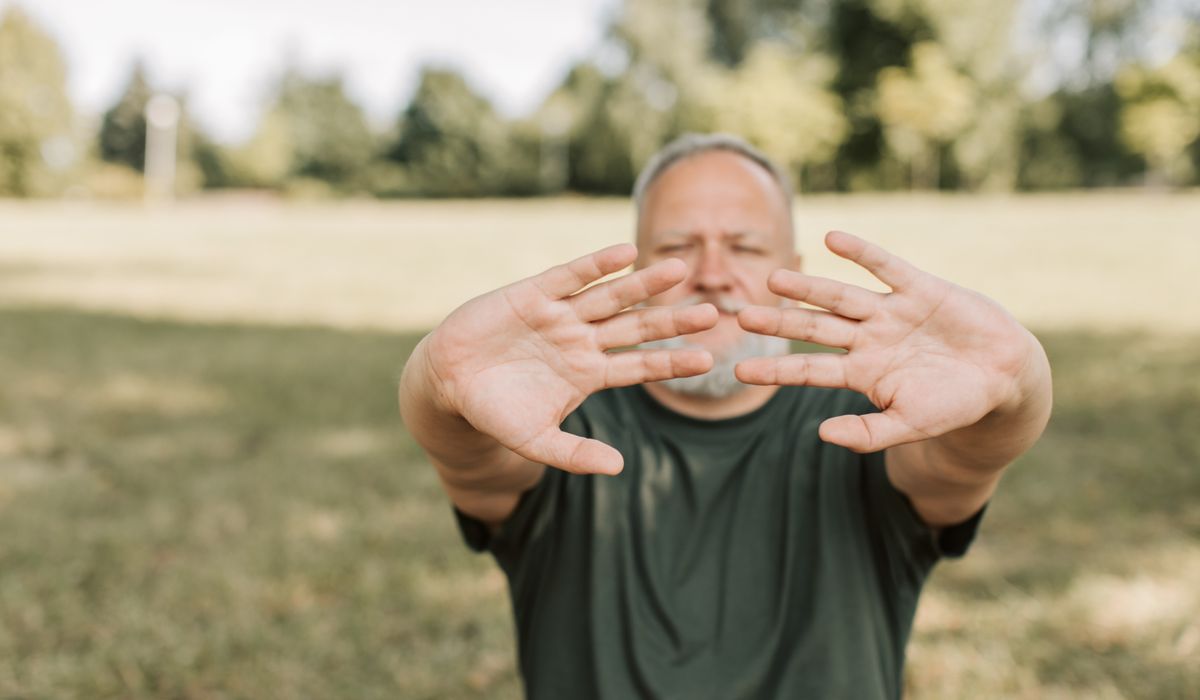
The hands are another trusty anchor, particularly in movements such as Grasping the Bird's Tail or the qigong exercise Holding the Ball. Rather than watching the hands with your eyes, feel them from the inside.
Notice the warmth between the palms when they face each other. Notice the slight stretch through the fingers, the softness of the wrists, the space under the armpits. Many students describe a gentle tingling or a sense of fullness — this is simply increased awareness, not something to chase.
If a thought pulls you away, the hands are there waiting. Feel the palm, feel the fingertips, and the mind settles back into the movement.
A useful habit is to choose one anchor for a whole session rather than switching every few seconds. Ten minutes of steady attention on the breath will teach you more than ten minutes of hopping between techniques.
You might also try linking anchors to moments in the form. Breath with the opening and closing, feet with every weight shift, hands whenever they move through the centre. This gives the wandering mind a rhythm to follow, a little like walking a path along the river rather than staring at a map.
Short and regular beats long and occasional. Fifteen minutes in the morning before the city wakes, or a few quiet minutes at lunchtime, will build the habit far better than an ambitious weekend session.
Anchors are scaffolding, not a destination. As your practice matures, you may find that attention rests more easily in the whole body at once — the breath, the feet, and the hands all present without needing to choose between them.
Until then, be patient and kind with yourself. Each time you notice the mind has wandered and you return, you are not starting from scratch. You are doing the practice. That return, repeated hundreds of times, is exactly where the calm, balance, and presence of tai chi and qigong are built.


We are not gonna make spamming
